Binance Hack Explained: How $6.3 Billion Left Binance in 20 Minutes
On the night of October 29, 2026, the Binance hack became the biggest crypto hack ever recorded. Blockchain intelligence firm TRM Labs estimates that about $6.36 billion moved out of Binance wallets across ten blockchains, most of it within roughly 20 minutes. In Nigeria, it started just after 9pm and most of the money was gone before many people went to bed.
Short videos explaining the attack have gone viral. Several get the big idea right but miss details that matter.
This guide walks through what actually happened, using Binance's own initial investigation report published on November 3 and findings from security firms Blockaid, TRM Labs and Fireblocks, and explains what it means for anyone who keeps crypto on an exchange.
Key takeaways
- About $6.3 billion was taken from Binance hot wallets on 10 blockchains on October 29, 2026.
- On Ethereum, the attacker used an EIP-7702 "Type 4 transaction" to turn one of Binance's busiest hot wallets, Binance 14, into a sweeper that only they could trigger.
- On the other chains, the attacker simply signed normal withdrawals. That points to deep access to Binance's signing systems, not a flaw in Ethereum.
- The attackers spent months getting in. Binance's report traces the breach to a fake job interview and tampered developer tools that compromised three wallet engineers' computers between June and October.
- The FBI has attributed the theft to North Korea. Binance says it has replaced 98% of the affected assets from its own funds, about $2.85 billion has been frozen, and withdrawals began reopening on November 1.
What happened in the Binance hack?
Like every large exchange, Binance keeps most customer funds in offline cold storage and a smaller amount in "hot wallets" that stay online so withdrawals can go out quickly. The attacker went after those hot wallets.
Binance's first statement pointed to a single compromised laptop however, its fuller report on November 3 told a longer story. The attackers did not break in on the night; they spent months working their way towards the people who run Binance's wallets.
How the attackers got in
- June: a wallet engineer searching online for an AI coding tool downloaded a tampered installer. Binance spotted it, replaced the device and changed the related passwords and keys, but the attacker may have learned who the engineer worked with.
- September: a second wallet engineer was approached through a legitimate recruitment platform and asked to complete an interview assignment. Setting it up on a work computer ran hidden malicious code that Binance's security software did not catch.
- October 20: from that computer, and using an internal AI tool, the attacker took control of two other wallet engineers' computers and found a token that allowed software to be deployed on Binance's systems.
- October 29: using those stolen credentials, the attacker deployed their own program inside Binance's infrastructure. It gave them access to the internal service that signs wallet transactions, letting them send funds outside the normal withdrawal process.
Binance says it found no evidence that any wallet private key leaked. It has not named the AI tool or explained exactly how it was used, and an independent review is planned.
With that access, the attackers ran two different plays:
- On Ethereum - they installed a trapdoor on one wallet, Binance 14, so it would hand its funds over on command.
- On Bitcoin, Tron and other networks - they sent ordinary looking withdrawals straight out of Binance's wallets.
On October 31, the FBI attributed the theft to TraderTraitor, a North Korean hacking unit it also blamed for the $1.5 billion Bybit hack in February 2025. Blockchain firms including TRM Labs and Chainalysis had already linked the attack to the same group.
How the "Type 4 transaction" trapdoor worked
Signatures and nonces: think of a cheque book
An Ethereum wallet works a bit like a cheque book. To spend from it, you need the owner's signature, which comes from the wallet's private key. Every cheque also carries a serial number, called a nonce, and a cheque is only valid if its number is the next one in line. Once cheque 15 has been used, any other cheque numbered 15 is worthless.
What EIP-7702 changed
In May 2025, Ethereum's Pectra upgrade introduced EIP-7702. It lets an ordinary wallet sign a special authorization that says, in effect: "From now on, when anyone interacts with me, run this piece of smart contract code." Those authorizations travel in a new transaction format known as a Type 4 transaction.
The feature is genuinely useful. It lets wallets bundle steps together, such as approving and sending a token in one go. But it also means that whoever wrote the attached code decides how the wallet behaves. And the attachment stays in place until the wallet signs a new authorization that replaces it.
The nonce problem, and "spray and pray"
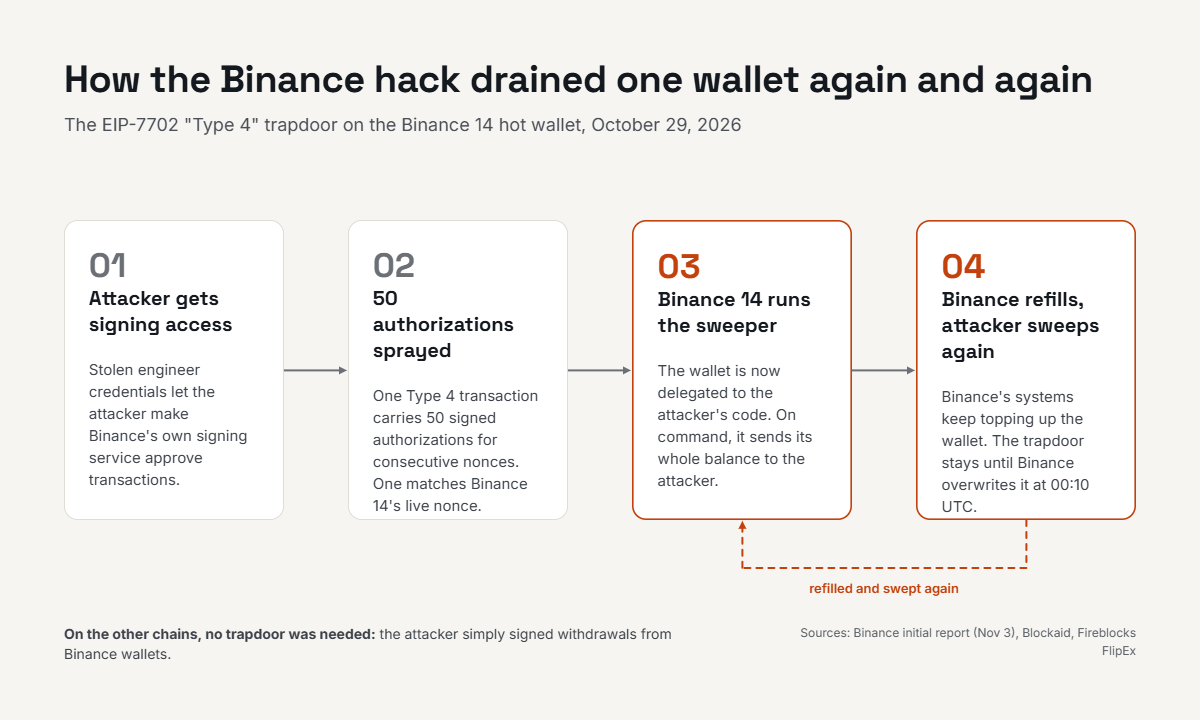
To attach their code to Binance 14, the attacker needed a signed authorization carrying the wallet's exact next nonce. That was a moving target. Binance 14 was processing customer withdrawals nonstop, so its serial number kept ticking up.
The workaround was simple and effective. The attacker prepared 50 signed authorizations, each for a consecutive nonce, and submitted them together in a single Type 4 transaction at 20:20:59 UTC. Only one of them needed to line up with the wallet's live nonce. One did.
The sweeper
The code they attached was a sweeper: a small program that, when the attacker triggers it, moves the wallet's balances to an address they control. Within minutes, Binance 14 sent 167,464 ETH and 63 other tokens, including about 1.615 billion USDT, to the attacker's hub address in one transaction. Acting through Binance 14, the sweeper also pulled 780 million USDC out of a linked Binance hot wallet.
Why it kept working
This is what made the attack so damaging. The sweeper was attached to the wallet itself, on the public blockchain. Binance's own systems did not know anything was wrong, so they kept automatically refilling Binance 14 to keep customer withdrawals flowing. The attacker simply swept the fresh funds again. Researchers counted three separate sweeps in the first 90 minutes, and the last stolen ETH transfer did not finalise until 23:56 UTC.
Kicking the attacker off Binance's servers would not have removed the trapdoor, because it did not live on Binance's servers. The fix was for Binance to sign and broadcast a new authorization from Binance 14 that replaced the malicious one. It did that at 00:10 UTC on October 30, nearly four hours after the trapdoor was installed.
Was EIP-7702 the problem?
Not really. EIP-7702 does not let a stranger take over any wallet they like. Every delegation needs a valid signature from the wallet being delegated, so the attacker could only do this because they could already get Binance's signatures. Several Ethereum researchers have argued the feature itself was not broken. What it did was turn a serious breach into a much bigger one, by letting the attacker drain one wallet repeatedly instead of once.
The other chains make the same point. There, the attacker needed no clever trick at all; they just signed withdrawals. The core failure was access to Binance's signing systems, reached through compromised employee computers rather than any flaw in the blockchain.
What the viral explainers got wrong
- "All $6 billion went through the trapdoor." - Only Binance 14 on Ethereum was turned into a sweeper. The rest was taken through ordinary signed transfers on other chains.
- "Changing the private key would not have helped." - An Ethereum wallet's private key cannot be changed, and Binance says it found no evidence any private key leaked. What mattered was the delegation attached to the wallet, which had to be overwritten with a new signed authorization.
- "A hacker got into a server." - Binance's report describes a months-long campaign against three of its engineers, starting with a tampered software download and a fake job interview.
Are Binance users' funds safe?
Binance says yes. It now puts the impact at about $6.34 billion and says it has replaced 98% of the affected assets from its own funds. Stablecoin issuers moved fast after the attack, with Tether and Circle freezing billions in USDT and USDC, and Binance's latest count is about $2.85 billion frozen or intercepted.
First, it is important to understand the distinction between replacing the assets and actually getting the stolen money back; most of what was taken is still in the attacker's hands. Second, "your balance is covered" was not the same as "you can use your money." Binance paused withdrawals straight after the attack and only began reopening them on November 1, starting with Bitcoin, then ETH, BNB and the main stablecoins. Other assets and networks have been coming back in phases since November 3.
When withdrawals reopened, users moved fast: Binance processed about $4.65 billion in withdrawals in under 10 hours on the first day.
For anyone in Nigeria who needed to cash out that week for rent, school fees or a supplier, those three days without withdrawals were the real cost of the hack. We look at what this means for Nigerian users in Is Binance Safe for Nigerians After the $6.3 Billion Hack?.
What to do if you keep crypto on any exchange
- Only leave on an exchange what you plan to trade or convert soon. Long-term savings belong in a wallet you control.
- Turn on withdrawal address whitelisting, and use an authenticator app for two-factor login rather than SMS.
- Ignore DMs, emails and "refund portals" offering Binance hack compensation. Scammers always follow big hacks. Use only official channels.
- If what you need is Naira, convert when you need it, on a platform that pays straight into your Nigerian bank account, instead of leaving spending money parked on an offshore exchange.
When you are ready to turn crypto into Naira, your FlipEx wallet lets you convert BTC, USDT and other supported coins at the rate you see and withdraw to your bank account, with no P2P stranger in the middle.
Frequently Asked Questions
How much was stolen in the Binance hack?
Binance puts the impact at about $6.3 billion. TRM Labs estimates $6.36 billion taken across ten blockchains.
When did the Binance hack happen?
On October 29, 2026. Binance says the first unauthorized transfers left its wallets at about 20:05 UTC, just after 9pm in Nigeria, and most of the money moved within about 20 minutes.
How did hackers get into Binance?
According to Binance's November 3 report, attackers compromised three wallet engineers' computers over several months, using a tampered software download, a fake job interview assignment and an internal AI tool, then used stolen credentials to reach the service that signs wallet transactions.
Who hacked Binance?
The FBI has attributed the theft to TraderTraitor, a North Korean state hacking unit. North Korea has rejected the claim.
What is a Type 4 transaction?
It is the Ethereum transaction format introduced by EIP-7702. It carries signed authorizations that let an ordinary wallet run smart contract code.
Will Binance refund users?
Binance says customers will not lose money. It has replaced 98% of the affected assets from its own funds and reopened withdrawals in phases from November 1.