President Tinubu's 2026 Executive Order on Virtual Assets & Crypto in Nigeria
(What It Means for Crypto Traders)
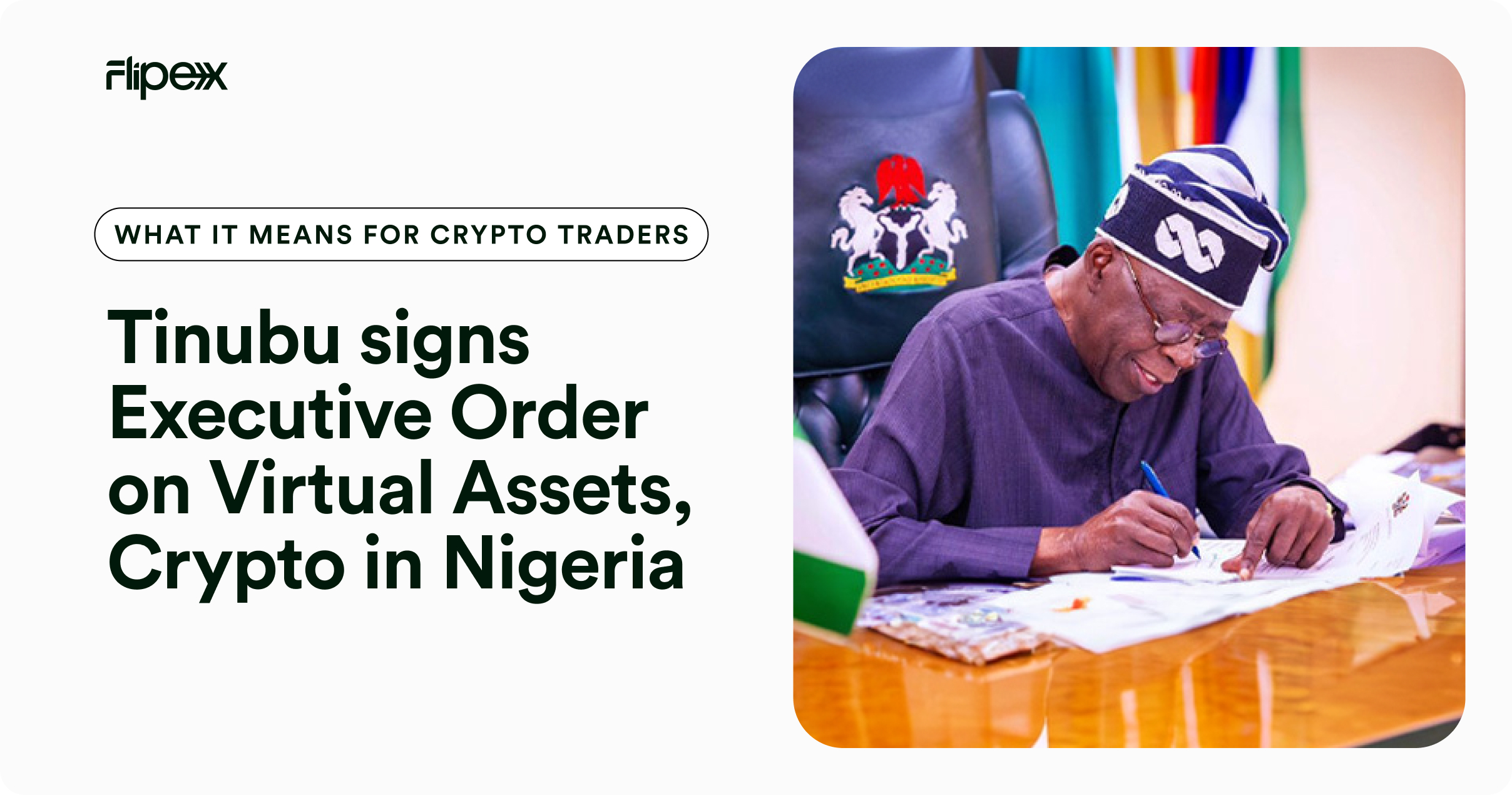
On Friday, July 17, 2026, President Bola Tinubu signed the Presidential Executive Order on Virtual Assets Coordination, 2026. It took effect the same day, but a lot of Flippers and Crypto traders in Nigeria are wondering what this means. For anyone in Nigeria who owns, trades, sends, or receives cryptocurrency, this is the biggest single piece of crypto-related regulation the government has issued in five years, and it changes how digital assets are supervised in the country.
This guide breaks down what the order actually says, how it connects to the crypto tax law that took effect in January 2026, and what all of it means for you, whether you are a full-time flipper, a Nigerian abroad sending USDT to family, or someone who just holds a bit of Bitcoin on the side.
Let's help you separate facts from fluff so, you can avoid all the fear-mongering that's expected to happen from this new executive order.
Quick Summary of President Tinubu's 2026 Executive Order on Virtual Assets and Crypto
- The Executive Order does not ban crypto. It does not create a new regulator. It does not change the tax rate. What it does is it forces the Central Bank of Nigeria (CBN), the Securities Exchange Commission (SEC), and the newly renamed Nigeria Revenue Service (NRS) to work together from the same playbook, chaired by the CBN.
- It creates a Virtual Asset Council to make policy and a Virtual Asset Office at the CBN to run day-to-day coordination.
- The council has 30 days from signing to publish a Harmonised Implementation Framework showing exactly how each agency will operate under the new coordination.
- The order is separate from, but complements, the Nigeria Tax Act 2025 (effective January 1, 2026), which folds crypto gains into personal income tax brackets and raised the top rate to 25 percent for high earners.
- For everyday flippers, this means regulated Nigerian crypto-to-Naira platforms like FlipEx will now have even clearer legal footing. It also means tax compliance is becoming enforceable rather than theoretical.
- For P2P traders on Binance, Bybit, and similar exchanges: the informal side of the market is exactly what the order is designed to bring inside the regulatory perimeter over time.
The full breakdown follows. If you want to read the primary source directly, the official Presidency statement is on statehouse.gov.ng.
What is the Presidential Executive Order on Virtual Assets Coordination 2026?
The Presidential Executive Order on Virtual Assets Coordination, 2026 was signed by President Bola Ahmed Tinubu to restructure and harmonise existing laws and regulations surrounding virtual assets particularly crypto. The order mandates existing agencies to work together to coordinate virtual assets.
The Presidency's justification for issuing it, per the official State House release, is that virtual assets increasingly blur the boundaries between currencies, securities, commodities, and payment instruments. When different regulators each treat digital assets differently, gaps open up that fraudulent operators can exploit. The order is intended to close those gaps by putting the relevant agencies under one coordinating structure. The Special Adviser to the President on Information and Strategy, Bayo Onanuga, made this explicit in the government statement: "The Executive Order does not create a new regulator or transfer powers between agencies." This is not a rebuild of Nigerian crypto regulation. It is a wiring diagram change.
From bank bans on crypto transactions in 2021, to Presidential Executive Orders now directing the coordination of Virtual Assets in 2026, it points to the fact that Nigeria's government recognizes Nigeria's crypto adoption domination in Africa and plans to establish a proper structure for it's operation with government providing oversight.
Nigeria's Virtual Asset Council: who is in charge of what?
At the centre of the order is a new body called the Virtual Asset Council. It has five members who previously had different operation frameworks for crypto but will now work together.
The Council's job is to:
- Set policy direction.
- Coordinate the activities of the participating agencies,
- Work with the Attorney-General of the Federation to develop a harmonised legal and institutional framework for virtual assets.
That framework, once developed, will be the reference document that guides everything from crypto exchange licensing to crypto tax reporting to fraud investigation.
Alongside the Council, the order creates a Virtual Asset Office, which will serve as the operational secretariat. This office is domiciled at the CBN and handles day-to-day coordination: information sharing among the participating agencies, applications from crypto operators, and reporting. Think of the Council as the board of directors and the Office as the operations team.
The 30-day Harmonised Implementation Framework
One of the most concrete deliverables in the Executive Order is a directive that the Virtual Asset Council must publish a Harmonised Implementation Framework within 30 days of the order being signed. That gives the Council until roughly mid-August 2026 to spell out exactly how each participating agency will operate under the new coordination model.
This framework is what everyday traders and platform operators should watch for closely. It will detail matters like: which agency handles which type of application, how KYC and reporting data flows between the CBN, SEC, and NRS, and what specific consumer protections apply when a Nigerian trades on a licensed platform versus an unlicensed one. When the framework is published, trust FlipEx to keep you updated about the details and how it will affect you.
How The New Virtual Assets Executive Order Connects to the Crypto Tax Law That Took Effect in January
The Executive Order is not the only piece of Nigerian crypto regulation you need to be aware of. It follows two other significant developments over the past 18 months that shows Nigeria's readiness for full scale crypto adoption.
Together, these three pieces form the current landscape:
Piece 1: The Nigeria Tax Act 2025
Signed into law by President Tinubu on June 26, 2025, the Nigeria Tax Act 2025 took effect on January 1, 2026. Among many other changes, it formally folds cryptocurrency and other digital assets into Nigeria's income and capital gains tax framework. Key points, per our coverage of the New Tax Law on Crypto and Digital Assets include:
- Crypto gains are now classified as "chargeable gains" under the personal income tax regime, replacing the flat 10 percent Capital Gains Tax that applied under the Finance Act of 2022.
- Individual traders pay progressive rates up to 25 percent depending on total income. Middle-tier traders see effective rates around 6 to 8 percent. High earners face the top 25 percent rate.
- Virtual Asset Service Providers (crypto exchanges and platforms) pay 30 percent corporate tax on their operating profits.
- Exchanges must register with the SEC, maintain KYC records, and report user transaction data to the NRS on a quarterly basis. Non-compliance attracts penalties starting at ₦10 million.
- The NIN and CAC (Corporate Affairs Commission) numbers now function as universal tax identifiers, simplifying compliance for individuals and businesses.
- Exemptions exist for small disposals: if your sales proceeds are under ₦150 million and your gain is under ₦10 million, the trade may be exempt. Small individual capital gains under ₦10,000 annually are also exempt.
Piece 2: The SEC capital requirements
In January 2026, the SEC issued Circular No. 26-1, a sweeping revision of minimum capital requirements across the capital market. Crypto operators took some of the biggest jumps.
- Digital Asset Exchanges and custodians must now hold ₦2 billion in capital, up from ₦500 million previously.
- Digital Asset Offering Platforms must hold ₦1 billion.
- Ancillary Virtual Asset Service Providers (blockchain analytics firms, compliance service providers) also face new capital thresholds.
This capital increase is a filter. Only serious, well-funded operators can meet the new thresholds. Small unlicensed operators will find it economically impossible to formalise, which effectively pushes them out of the Nigerian market over time.
Piece 3: The Executive Order (July 17, 2026)
The Executive Order is the coordination layer that ties the above two pieces together. The Tax Act sets out how much tax you pay. The SEC capital regime sets out who can operate a crypto business in Nigeria. The Executive Order forces the agencies that oversee both to work together, share data, and speak with one voice.
Read together, the message from the government is:
crypto is now part of the formal Nigerian financial system, subject to the same regulatory and tax discipline as any other financial asset.
What Does The Executive Order on Virtual Assets Mean for you?
The executive order's application relies on how you use crypto and other digital assets.
If you are an everyday flipper trading gift cards and crypto to Naira
The most immediate impact is on the platforms you use. Trading on regulated Nigerian crypto-to-Naira platforms like FlipEx becomes safer and more predictable because the platforms themselves are operating under clearer regulatory obligations. Payout speed, wallet integrity, and dispute resolution all benefit from the coordination.
Tax obligations become real. If you have been trading crypto in Nigeria and not filing capital gains, the 2026 Tax Act formally brings your activity into scope, and the NRS now has data-sharing arrangements with SEC-licensed platforms. For most everyday flippers with modest gains, the tax bill is small. For heavier volume traders, it is meaningful. Either way, the compliance expectation is that you keep records.
The old P2P workflow (Binance P2P, WhatsApp trades, informal handoffs) is now the least regulated part of the market and increasingly the highest risk. Naira payments from unknown counterparties in P2P trades will draw more bank scrutiny than they used to. For a fuller look at the trade-offs, see how to sell crypto without P2P in Nigeria.
If you are a Nigerian abroad sending crypto to family
Nothing changes about your ability to send USDT, BTC, or other assets to a family member in Nigeria. What changes is the receiving side. When a Nigerian recipient converts the crypto to Naira, doing so through a regulated platform means the transaction has a clean audit trail, the funds land in a bank account without suspicion of illicit sourcing, and the counterparty (the platform) is registered.
If the recipient converts through a P2P trader whose Naira comes from an unverified source, the same funds might trigger a bank compliance review and account freeze. Sending through the informal route can inadvertently create problems for the person you are trying to help.
If you hold Bitcoin, Ethereum, or altcoins for the long term
Holding is not a taxable event. You pay capital gains tax only when you dispose of the asset (sell, swap, convert to Naira, or use it to pay for goods and services). Between now and the moment you sell, the Executive Order does not change your legal position at all.
When you do sell, keep clear records of the buy date, the buy price in Naira, the sell date, the sell price in Naira, and the platform used. This is what you will need if the NRS ever requests documentation, either during routine filing or during an audit.
If you receive USDT for freelance or remote work
USDT received as payment for work is treated as income at the Naira value on the day you receive it. When you later sell that USDT for Naira, any gain or loss from movement in the exchange rate is a separate capital gains event.
Example: You receive $500 USDT for a project on a Monday when the effective Naira value is, say, ₦800,000. That ₦800,000 is income and gets taxed at your income tax rate. If you hold that USDT for two months and sell when the effective Naira value has risen to ₦850,000, the extra ₦50,000 is a capital gain, taxed separately. If the Naira had strengthened and the USDT was worth only ₦780,000 when you sold, you would have a ₦20,000 capital loss, which can offset other gains within the same year. Check the live Naira value of any crypto asset on the FlipEx Rate Calculator before you convert.
If you run a crypto business, exchange, or trading service
The Executive Order affects you most heavily. Your business is now supervised through the coordinated framework: SEC licensing, quarterly NRS reporting, NFIU AML compliance, and the underlying capital requirements from the January 2026 SEC circular. Small unlicensed operators face an existential decision about whether to formalise or exit the Nigerian market. Large operators will find the environment more predictable but also more demanding.
For an emerging view of the sector, see coverage from Nairametrics and TechCabal.
Frequently asked questions
Does this Executive Order ban crypto in Nigeria?
No. The New Executive Order on Virtual Assets does not ban crypto instead, it formally recognises virtual assets as part of the Nigerian financial system and coordinates their supervision across agencies. The 2021 CBN restriction on bank-crypto dealings was already reversed in December 2023. This order continues the direction of formal integration, not prohibition.
Do I need to register anywhere personally to keep trading crypto?
You do not need to register as a crypto entity as an individual. What you do need is a Tax Identification Number (TIN), which is now automatically linked to your NIN under the 2026 tax framework. If you use SEC compliant platforms like FlipEx, the platform handles its own regulatory obligations. Your obligation is to keep records of your trades and file taxes at year-end if your gains exceed the exemption thresholds.
How does the NRS know how much crypto tax I owe?
SEC-licensed exchanges are required to report user transaction data to the NRS quarterly under the 2026 Tax Act. If you trade on a licensed platform, the government has visibility into your gross activity. If you trade only P2P or on offshore platforms, the government has less visibility, but the burden of accurate self-reporting is on you, and blockchain analytics are increasingly used by regulators.
Will Binance and Bybit be affected by the Executive Order?
Any exchange serving Nigerian users falls within the perimeter that the Virtual Asset Council will now supervise. Whether specific offshore exchanges continue serving Nigerian users depends on their willingness to register with the SEC and comply with reporting obligations. For the current state of major offshore exchanges in Nigeria, see Binance banned: where to trade crypto to Naira in Nigeria.
What is the Virtual Assets White Paper the government mentioned?
Alongside the Executive Order, the Federal Government is finalising a comprehensive Virtual Assets White Paper that will outline Nigeria's long-term policy direction and implementation priorities for the sector. It has not been published as of this article's date. When released, it will be the definitive reference for how the government thinks about crypto over a five to ten year horizon.
Does the Executive Order affect stablecoins like USDT specifically?
Yes, but as part of the general definition of virtual assets. The order and the underlying tax law both treat stablecoins as virtual assets, meaning gains from USDT trading are chargeable under the same framework as gains from Bitcoin or Ethereum. Stablecoins are the largest single crypto category in Nigerian usage, so they are effectively at the centre of what the framework governs.
What is the CBN regulatory sandbox mentioned in the Executive Order?
As part of the coordinated approach, the CBN is proceeding with a regulatory sandbox for virtual assets. A sandbox is a controlled environment where new crypto products and services can be tested with real users under regulatory supervision but with lighter compliance burdens for a defined period. This lets the government observe how innovations behave before deciding whether to formally license them. Full sandbox details have not yet been published.
If I have historical crypto trades from 2023 or 2024, are they taxed?
The 2026 tax framework applies to trades from January 1, 2026 onwards. Earlier trades were governed by the previous framework, which included the 10 percent flat Capital Gains Tax where applicable. If you have unfiled historical gains, consult a Nigerian tax professional. The NRS has broad information-gathering powers under the new law, and voluntary disclosure is generally treated more favourably than post-audit correction.
Where FlipEx Stands Concerning the New Executive Order on Virtual Assets Coordination
FlipEx has operated in the Nigerian crypto-to-Naira and gift-card-to-Naira space since before the current regulatory framework existed. Our position on the Executive Order is straightforward: we support coordinated regulation of the sector. Clearer rules protect users, allow legitimate operators to compete on service quality rather than regulatory arbitrage, and reduce the fraud that has cost Nigerians substantial sums over recent years.
Practically, this means:
- We continue to comply with the operating requirements of SEC-licensed Virtual Asset Service Providers in Nigeria.
- We continue to hold user funds in regulated banking channels and pay from a business account, not from individual counterparties.
- We continue to publish live rates transparently through the Rate Calculator and never add hidden fees.
- We continue to invest in verification and fraud detection to keep bad actors off the platform.
- When the Virtual Asset Council publishes the Harmonised Implementation Framework in the coming weeks, we will update our processes to align with any new requirements.
If you want to trade crypto directly to Naira without P2P risk, sell USDT or Bitcoin from a foreign wallet, or convert international gift cards, FlipEx is built for exactly that flow. See the FlipEx crypto to cash product page or check current rates on the Rate Calculator. For deeper context on how our platform handles specific asset types, see how to sell Bitcoin for Naira on FlipEx or how to make money with cryptocurrency in Nigeria.
The bottom line
Nigerian crypto regulation moved from ambiguity to formal structure in about eighteen months. The 2026 Tax Act put crypto gains inside the personal income tax net. The SEC capital regime raised the entry bar for operators. And now the Executive Order forces the CBN, SEC, and NRS to work as one system. None of this is a ban. Most of it is a natural consequence of Nigeria being one of the most crypto-active countries in the world and eventually needing rules that match the reality.
For everyday flippers, the practical effect is: use regulated platforms, keep records, file taxes at year-end. For long-term holders, nothing changes until you sell. For crypto businesses, the era of informal operation is ending. For Nigerians abroad sending funds to family, use platforms with clean bank rails to avoid triggering compliance reviews on the receiving end.
FlipEx will keep you updated as the Virtual Asset Council publishes the Harmonised Implementation Framework and as the Virtual Assets White Paper is released.